Cameron Hagaman
Cameron Hagaman (b.2000) is a teacher and student of music focusing primarily on composition and music research. Based in New York, his works are collaborative and interdisciplinary, aiming to break down the hierarchical relationship between composer and performer. His current body of work is presented primarily within the traditional concert hall; however, through continued collaboration with performers, dancers, painters, and artists across disciplines, his music will ultimately be performed exclusively in freely accessible public spaces, where it can be experienced by all.
Composer, Researcher, Teacher
In this video - Aesthetic Approach
“Contemporary classical music, together with many of its aesthetic movements—serialism, spectralism, New Complexity, and others—has become an increasingly esoteric artistic practice, one whose primary audience is often other composers and academics. Its accessibility to broader audiences has steadily diminished. Like many living composers, I continually ask myself: how can I write music that resonates both with my colleagues and with listeners who have no formal musical training?
My current approach is to separate compositional process from sonic result. Beneath the surface, my works are constructed through rigorous systems: complex rule-based procedures, carefully derived pitch sets; in other words, a broadly serialist methodology. From this process, I then try to create music that is programmatic, melodically expressive, and more consonant in its sonic character, allowing technical rigor which can be studied, analyzed, and appreciated by my colleagues, to coexist with immediacy and emotional accessibility.”
My Artistic Statements
On Notation
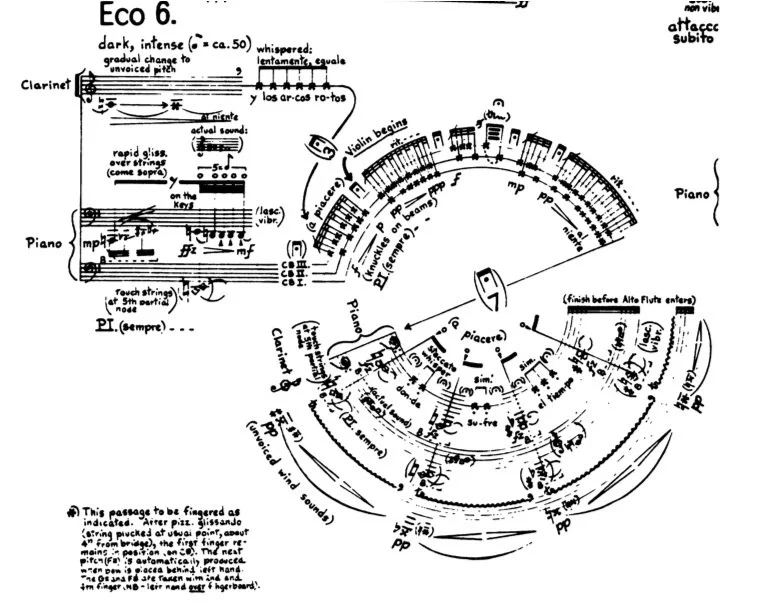
To facilitate multiple performances, notation has become a means of accommodating diverse musical approaches, varying levels of performer proficiency, the physical characteristics of performance spaces, amongst other variables. As a result, there is and will always be an ongoing discourse surrounding what a score should contain to maximize clarity for both present and future performers. My process is much more singular and qualatative. My music instead embraces a hyper-personalized approach to notation, tailored to a specific soloist or ensemble in order to provide the clearest possible artistic and technical direction. The complexity of each work, including its use of extended techniques, is shaped around the unique capabilities of its performer(s), without any consideration for subsequent performances. A single, deeply collaborative realization between composer and performer, is for me, sufficient.
On Memory
I have become increasingly interested in the manipulation of experienced time versus real time, and the psychological nature of memory. How can I use psychology in the composing of form?
On Process
I aim to break the hierarchy and linear process that is composer → conductor → performer. Music is the most communal of arts, yet the composer so often creates it in isolation. A musical work should not be the recording of a singular mind, but the meeting of many.
On Originality
I believe that the modern composer is no longer burdened to belong in a clearly defined aesthetic. The conscious adoption of polystylistic methods in previous genres of classical music were limited and secondary to the current identity of the time. The death of originality now allows the composer to consciously work freely across multiple influences, drawing from diverse musical languages without the obligation to resolve them into a single unified style.
“Memory and quotation may function as a means to reflect upon contemporary artistic, cultural, social, and political phenomena.” - Reiko Füting
Resonating Quotes
"The more constraints one imposes, the more one frees one's self." - Igor Stravinsky
"Music should be able to stand on its own without a program." - Steve Reich